Snakes -n- Scales presents environmental education programs for people of all ages, with an emphasis on learning through enjoyment. It is our philosophy and our practice that people remember best what they enjoy. Therefore, if anyone, children or adults, are to learn desperately needed environmental values, ecology, conservation, respect for life on Earth or simply not to be afraid, they will learn it well if they enjoy it!
The animals used in our programs are almost all orphans rescued from a variety of unfortunate situations. Some are unwanted or abused pets, others were confiscated by authorities, still others were picked up in neighborhoods, along roads, from abandoned apartments or humane organizations. These animals are important to us and are given appropriate foods, habitat, medical care and a safe, secure home for the rest of their lives.
We are not a pet store. Snakes-N-Scales is part of an amazing network of state and local officials, humane, rehab and zoological professionals working constantly toward the proper care, rescue and preservation of animals both in the wild and in captivity.
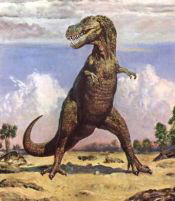
The Dinosaurs and Fossils School Assemblies This is a quick peek into the past through an investigation of the methods used by paleontologists. Modern animals are compared with ancient ones to identify similarities and differences. Some facts can be learned and other times only hypothesizes can be drawn. The purpose of this program is learn how science works, take a glimpse at animals long vanished, like Dinosaurs and see modern animals as instructive for learning about the past. This program does discuss evolution, and cannot be performed in any other way.
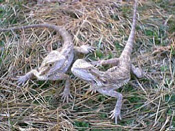
“Arid and Xeric” Bearded Dragons These cute little guys are found in the deserts of Australia hunting small insects and defending their modest plot of sand against rival dragons. Their small size and ease of care make them popular pets.
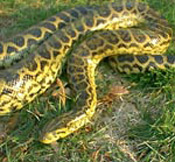
“Gums” Yellow Anaconda Though nothing like the monsters they are often portrayed as, the Anaconda can reach 400 pounds and over 23 feet in length. All five species live in South America. Anacondas are constrictors and eat a variety of animals including capybara (giant Guinea pigs), caiman, ocelots, monkeys and parrots. Gums was one of many victims of abuse, she was rescued from a pet store.
“Wendl” Common Snapping Turtle Six years ago, a friend rescued a turtle the size of a quarter from a neglectful owner and brought it to me in a “Wendy’s” salad container. Wendl has learned not to bite when he’s out of the water, but we still can’t potty train him!
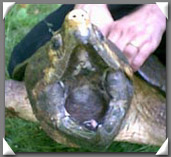
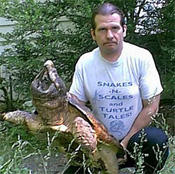
The largest fresh water turtle in the world is the Alligator Snapping Turtle. They catch fish and turtles by luring them into their mouth using a bait-like bony finger at the tip of their tongue. Once the food animal enters the snapper slams closed its mouth. The sharp sides of the turtle’s beak chop the animal into
swallow-able chunks. These snappers have incredibly powerful jaws that can smash through even an adult turtle’s shell. This snapper’s name is “Guillotine”.
Guillotine was an unwanted pet. It’s easy to understand why they are not recommended as pets!!
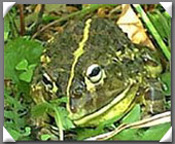
“List at Rest“ African Bull Frog This is “List”. He’s called that because he leans to one side. He was born with a problem in his brain, spine or ears and this causes him to look at the world slightly sideways. It doesn’t affect his appetite! African Bullfrogs are known for their ability to eat animals nearly as large as they are! This includes bugs and fish but also birds, frogs, snakes, mice and even baby crocodiles!! List was a pet store animal that nobody wanted to buy because he was “damaged”.
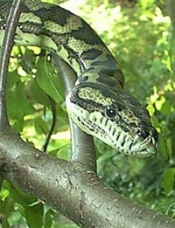
“Hangin’ Out“ Carpet Python Carpet pythons are not giants like the Burmese and African Rocks are but they can still reach over 12 feet. In the wild they are bird eaters but they also like rodents. I don’t have a name for this guy
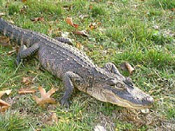
“Blue” American Alligator Blue is a four or five year old gator who was found in the back of a pick-up truck while driving through town. To own a gator or croc, you must possess a special permit. Without the proper permits, gators are illegal. All alligators and crocodiles require experienced handlers. We have the proper permits and are one of the few organizations allowed to use these types of animals in educational settings.
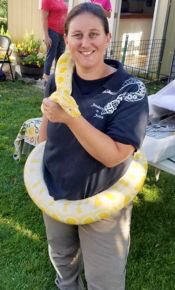
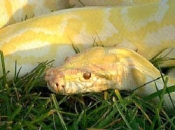
“Shakespeare” Albino Burmese Python Shakespeare was bred for beauty, but is too big to be practical. These lovely snakes can grow to be two hundred pounds. Shakespeare was part of an acting troop until he got too big for the act.
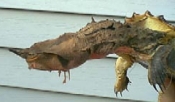
“Siphon” Matamata Turtle Siphon certainly is the most bizarre turtle and one of the strangest looking animals. The matamata is a fish vacuum dressed up to look like a floating log. This log-like appearance keeps matamatas out of the jaws of predators like the jaguar.